My research has involved interviewing various people with polio related disabilities about their lived experiences.
Between January and March 2026, I interviewed seventeen people in Britain, including four people who contracted polio in Kenya then moved to Britain. I will also interview people in Kenya about their experiences.
Some excerpts of their stories and experiences are included here.
Moz’s First Day out of Hospital
In Britain, polio rehabilitation often involved long-term hospitalisation. Children were separated from their parents, and normal childhood experiences. Whilst in hospital they experienced various treatments, including physiotherapy, splinting, hydrotherapy and sometimes orthopaedic surgeries.
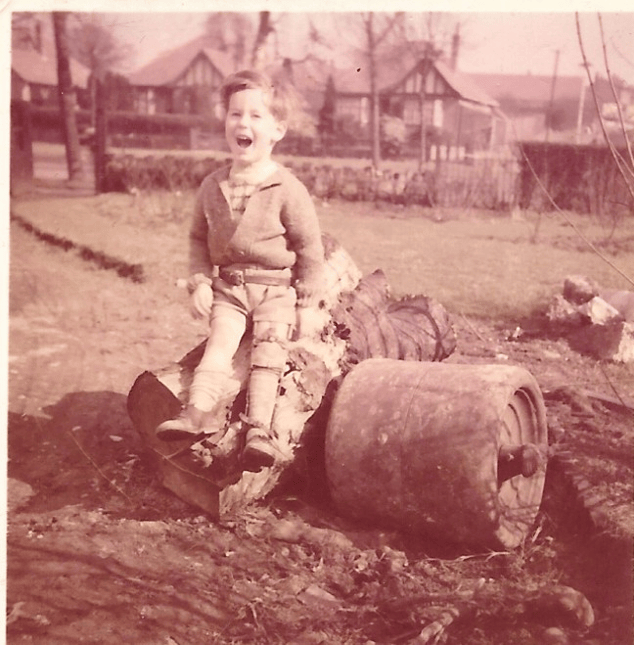
Being discharged from hospital and returning to ‘normal life’ was often a significant moment, marked by intense emotions.
Moz described the above photograph:
‘I was sitting up, and I was absolutely joyful. I was, I got my mouth open, and it was just, God, this is the open air. It’s wonderful.‘
Jim’s life on the rehabilitation ward
Jim was severely paralysed by polio, and lived in Queen Mary’s, London, for four years, and was treated using the Sister Kenny Method, which involved intensive rehabilitation with hot packs alongside stretching and movement exercises.
He described how:
‘There was a very good spirit in the ward. Between age and six and 10, of course that’s when you’re a bit of a lad. And of course, a number of us were really quite bright and breezy, and the beds were the old metal ones with the wheels on and what have you? We could punt them around the ward, you know, we were, we were game enough […] It was surprising, what you can be amused by‘
Joyce’s experience of physiotherapy
Physiotherapy involved structured and repetitive exercises which aimed to restore functional capacity and train bodies to move ‘correctly’. It was often intensive and could continue long after discharge from hospitals.
Joyce described how:
‘Your parents were not allowed to accompany you with a physio, but my mother could hear me screaming, and on one occasion, she insisted on seeing what was happening […] they were literally pulling my legs. I think one of the theories was that if you did that, you might stimulate growth and repair which now sounds rather bizarre, but you know they didn’t have any remedies […] My mother was extremely unimpressed.‘
Jean’s orthopaedic surgeries
Often, rehabilitation would involve orthopaedic surgeries, on the bones and tendons, including tendon transfers and fusion of the ankles. However, surgical outcomes were not always clearly explained to people.
Jean described how:
‘I was told that when I was 16, and I’d sort of stopped growing, that’s when they would do the surgery, and they would, um, and I can’t remember the exact terms they used, but in my head, I thought they were gonna make it, right. Really thought it was all gonna be dealt with. Um, but I obviously didn’t articulate this to anybody, so nobody ever explained that they would make some improvements, but it wasn’t gonna be, you know.’
 poliothings